Vincent and Emmanuel Ogereau: Les Vignerons de l’Année Loire
Congratulation to the Ogereau family for being named the Loire Valley’s Winemakers of the Year in 2026 by Le Guide Hachette des Vins!
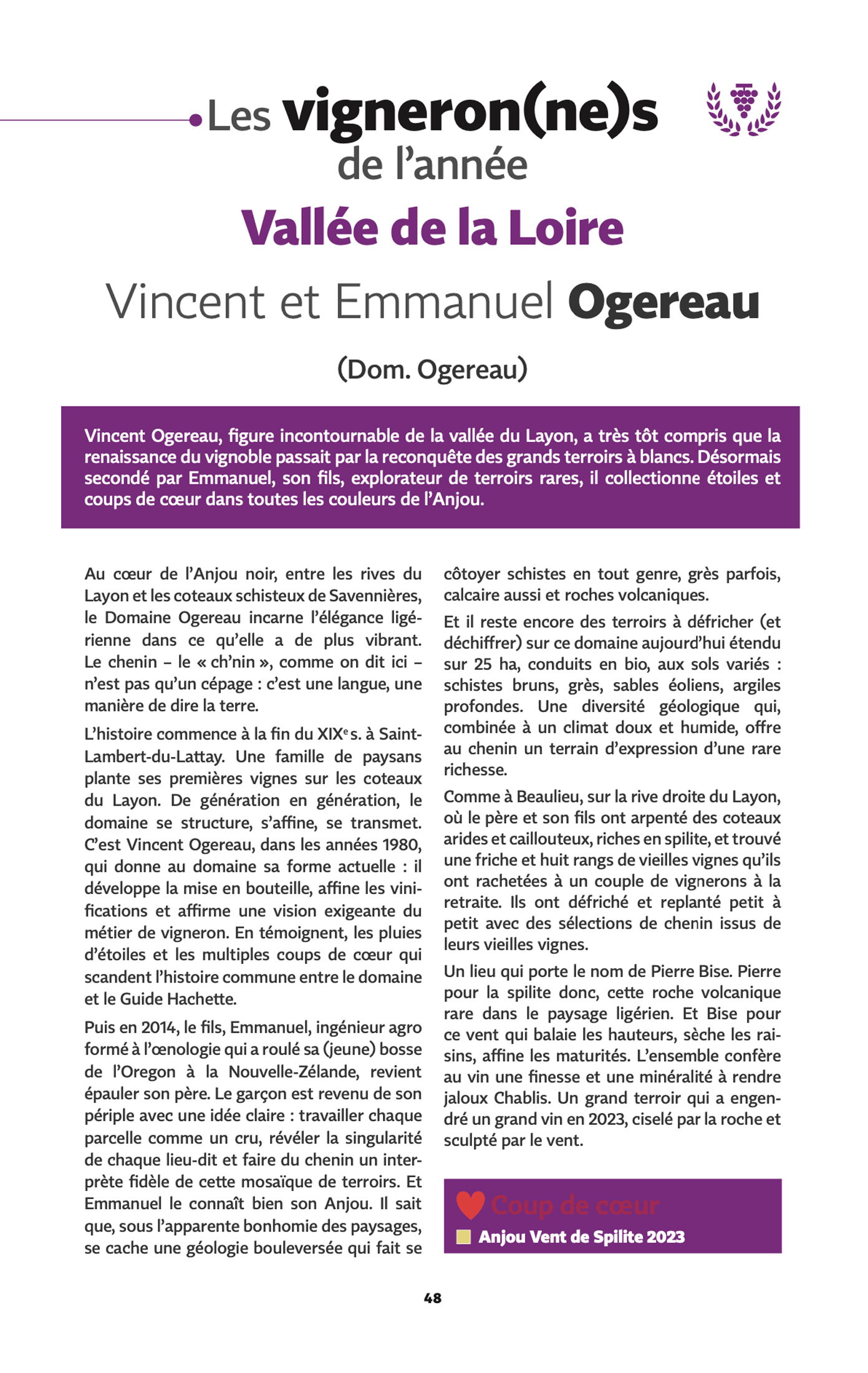
Vincent Ogereau, a key figure in the Layon Valley, understood early on that the renaissance of the vineyards depended on the reconquest of the great white wine terroirs. Now assisted by Emmanuel, his son, an explorer of rare terroirs, he draws high praise for his Anjou wines in all colors.
In the heart of Anjou Noir, between the banks of the Layon and the schist hillsides of Savennières, Domaine Ogereau embodies Loire elegance at its most vibrant. Chenin— “ch’nin,” as they say here —is not just a grape variety: it’s a language, a way of expressing the land.
The story begins in the late nineteenth century in Saint-Lambert-du-Lattay, where a family of farmers planted their first vines on the slopes above the Layon. From one generation to the next, the estate took shape—was organized, refined, and handed down. In the 1980s, Vincent Ogereau gave it its modern form: he began bottling at the domaine, sharpened the winemaking, and set an exacting standard for the craft.
In 2014, his son Emmanuel—an agricultural engineer with oenology training, fresh from formative stints in Oregon and New Zealand—returned to join him. He brought a clear conviction: to treat each plot as its own cuvée, reveal the individuality of each lieu-dit, and let Chenin speak faithfully for a mosaic of terroirs. Few know Anjou as he does. Beneath its gentle landscapes lies a restless geology—schist of every kind, with pockets of sandstone, limestone, and volcanic rock.
Today the organically farmed estate spans 25 hectares across varied soils—brown schist, sandstone, windblown sands, and deep clays. This diversity, married to a mild, humid climate, offers Chenin an unusually rich register of expression.
On the right bank of the Layon, in Beaulieu, the father and son walked the arid, stony slopes rich in spilite and found a former wasteland and eight rows of old vines, which they acquired from a retiring couple. They cleared the brush and replanted gradually with selections of Chenin from their oldest parcels. They named the place Pierre Bise: “Pierre” for the spilite—a rare volcanic rock in the Loire—and “Bise” for the wind that scours the heights, dries the grapes, and polishes ripeness. The result is a wine of finesse and minerality that could make Chablis envious—a great terroir that, in 2023, yielded a great wine, chiseled by stone and sculpted by wind.